





 download PDF
Introduction
The world is experiencing unprecedented demographic transition. WHO estimates that by 2050 the global population aged over 60 years will double to 2.1 billion, with those aged over 80 years projected to triple to 426 million1. These shifts are most pronounced in low- and middle-income countries, which by 2050 will be home to 66% of the world’s older population. As Khan observed, the present century represents ‘the first era in human history when the world will no longer be young’2. This demographic transformation is irreversible, country specific, and shaped by intersecting forces such as migration, climate change, and shifting mortality and life expectancy patterns, necessitating nationally led responses informed by global strategies2,3.
Population ageing has far-reaching implications for labour markets, financial systems, housing, transport social security and health care3,4. A narrative literature review by Khan et al identified a broad range of associated public health challenges including rising chronic disease burden, increasing disability, caregiving shortages and deficiencies in long-term care5. These challenges are particularly acute in regional areas, where access to health care is constrained by workforce shortages, geographic isolation and socioeconomic disadvantage5. Addressing these challenges requires collaborative, multisectoral policy responses, grounded in high-quality evidence and meaningful stakeholder engagement4,5.
Healthy ageing, an overarching goal of the UN Decade of Healthy Ageing (2021–2030)4, emphasises maintaining functional ability, defined by WHO as an individual’s sustained ability to function effectively in daily life. Functional ability reflects a dynamic interplay between intrinsic capacity – encompassing physiological and psychological health, health behaviours and disease status – and the physical, social and policy environments in which people live4.
Closely related to healthy ageing is the concept of ageing in place: the ability of older people to remain in their own homes and communities for as long as possible, with or without support6. A scoping review by Pani-Harreman et al identified five foundational elements of ageing in place: ‘place’ (the home environment and sense of belonging), social networks, formal and informal support, technology, and personal characteristics such as adaptability and resilience6. Access to transport, home maintenance, personal care and health care are critical enabling conditions6, while inadequate infrastructure and service fragmentation constitute barriers. Older people with stronger adaptive capacities and support networks are more likely to age in place successfully6.
For rural-dwelling older adults, these enabling conditions are frequently absent or compromised7,8. Compared with their metropolitan counterparts, rural older adults experience greater health vulnerabilities and poorer health outcomes driven by disadvantage and elevated health risk factors9. Barriers to ageing in place are particularly pronounced in rural settings and include workforce shortages, limited availability of community-based services, inadequate public transport, changing family structures driven by the out-migration of younger generations, and reduced awareness of available supports among older people and their carers7,8,10. Social isolation further compounds these challenges as community-based programs that promote engagement and wellbeing remain limited in both availability and design scope11,12.
There is growing recognition that effectively meeting the needs of ageing rural populations requires multi-dimensional, person-centred strategies that prioritise autonomy, respond to diversity and strengthen independence among the ageing13,14. Participatory co-design approaches that engage older adults in the development and evaluation of services offer promise in improving program relevance, uptake and resource efficiency11,15,16. However, the evidence base underpinning such approaches in rural aged care contexts remains underdeveloped.
To address this gap and inform future research and policy development, this scoping review was conducted to map the existing literature on the care needs of community-dwelling older adults in rural areas. Scoping reviews are appropriate when the purpose is to systematically chart the scope, range and nature of evidence on a topic, identify key concepts and research gaps and generate an agenda for future inquiry, rather than to synthesise evidence for clinical decision-making17,18. This review was guided by the question ‘What are the healthcare needs for community-dwelling older people in rural areas?’ Distinct from prior reviews, it integrates three specific dimensions: a focus on community-dwelling older adults, attention to diverse ethnic and cultural contexts, and an explicit focus on rural settings. The findings are presented thematically, organised around five research focus areas identified in the included studies, and discussed in relation to implications for workforce development, service design and policy.
Methods
The first purpose of this scoping review was to comprehensively examine the extent and characteristics of primary research studies and grey literature focused on the care needs of community-dwelling older people in rural areas. The second purpose was to develop a summary of the current evidence to inform a research agenda19. Close attention was paid to the systematic approach to undertaking scoping reviews detailed in the JBI Manual for Evidence Synthesis, and a completed PRISMA-ScR checklist was included as an appendix to the submission20,21. This scoping review was originally registered on Open Science Framework in January 2024 and was re-registered in January 2025 (project number osf.io/8nerf). The design, inclusion and exclusion criteria have not been altered from the original registration.
A benefit of using a systematic approach to the scoping review process was the provision of clear guidance to a large interdisciplinary team from nursing, social work, business, and computing and mathematics backgrounds. During the scoping review process the team met every 2 weeks and freely communicated between meetings to ensure queries were addressed.
The topic that was the focus of the review was decided in a team meeting along with draft inclusion and exclusion criteria. A key team member was a specialist librarian who assisted in the development of search terms. A preliminary search of Ovid MEDLINE and CINAHL Plus with Full Text databases was undertaken. Draft search strings for Scopus, Informit, ProQuest Health and Medicine were then developed, trialled and refined by the research assistant and librarian.
After the search strings and inclusion and exclusion criteria were finalised, a search of Ovid MEDLINE, CINAHL Plus with Full Text, Scopus, Informit, and ProQuest Health and Medicine databases was undertaken on 3 May 2024. The full search string for Ovid MEDLINE is shown in Table 1.
This search located 631 studies, which were imported into Covidence for screening. Articles were included if they focused on people with the following characteristics: adults aged 60 years or older or Aboriginal or Torres Strait Islander people 45 years or older living in a rural area; people residing in accommodation in the community in a residence owned by the older person, in private rental accommodation or in the independent living section of a retirement village; people living independently; people who access services provided by government or private agencies; and people living with a formal or informal carer. The conceptualisation of an older person in the inclusion criteria comprises varying cultural, social and geographical contexts. The definition of a rural area was determined by individual articles included in the review. Team members were also encouraged to include articles where the participants were identified as older people by the researchers conducting the respective studies22. The parameters of ‘health services’ for older people were also wide in order to ‘generate breadth of coverage’19. Additional inclusion criteria were articles published from 2014 to April 2025, were published in English, were peer-reviewed articles or conference presentations, and were qualitative, quantitative or mixed-methods studies. The articles that contained data from both rural and metropolitan areas were excluded if data were not disaggregated.
Covidence enabled all team members to participate in the screening process. The PRISMA flow chart (Fig1) shows that 101 duplicates were identified by Covidence. Title and abstract screening were performed on 530 articles, and 374 articles were excluded. Full-text screening of 156 articles excluded a further 138 articles. This resulted in 18 studies included at the conclusion of this process. An additional three peer-reviewed articles were located during manual searches, for a total of 21 included articles at this stage.
The scoping review process was iterative in nature19. This is highlighted by the decision to conduct a separate grey literature search. The purpose of including grey literature with an Australian focus was to capture literature reflective of recent changes in policy and practice in the aged care sector in Australia. A grey literature search was conducted on 14 October 2024. Following discussion, one additional key government document was included in the review, bringing the number of included articles to 22.
A second search of all databases was conducted using the same search terms on 1 April 2025 with the aim of identifying articles published between October 2024 and April 2025. This yielded one additional article. Therefore, the total number of articles included in the review was 23.
The data charting of peer-reviewed articles was done within Covidence, with a custom data extraction tool developed and trialled by the team. Five articles were trialled and the results compared to ensure consistency of responses. The Mixed Methods Appraisal Tool informed the data appraisal questions23. While a critical appraisal of bias or methodological limitations is not recommended for a scoping review, the utilisation of the tool provided an additional depth of understanding of the included articles17,19,20. The reviewers performed data extraction independently and other team members completed the comparison phase. No studies were excluded from the review following the appraisal process.
Table 1: Ovid MEDLINE search strings
| # | Query |
|---|---|
| 1 | exp Rural Health/ or exp Rural Health Services/ or exp Rural Population/ or Regional Health Planning/ or Regional Medical Programs/ or (rural or regional).ti,ab. |
| 2 | exp Aged/ or exp geriatrics/ OR (aged OR older OR elder* OR geriatric OR gerontolog* OR senior* OR old age).ti,ab. |
| 3 | exp "Health Services Needs and Demand"/ or exp Health Services Accessibility/ or ((health* or care) adj3 (needs or need or service* or plan*)).ti,ab. |
| 4 | exp Independent Living/ or (community dwelling or (living adj3 home) or unsupported living or independent living or community living or independence or home based or home dwelling or age in place or aging in place or community residing).ti,ab. |
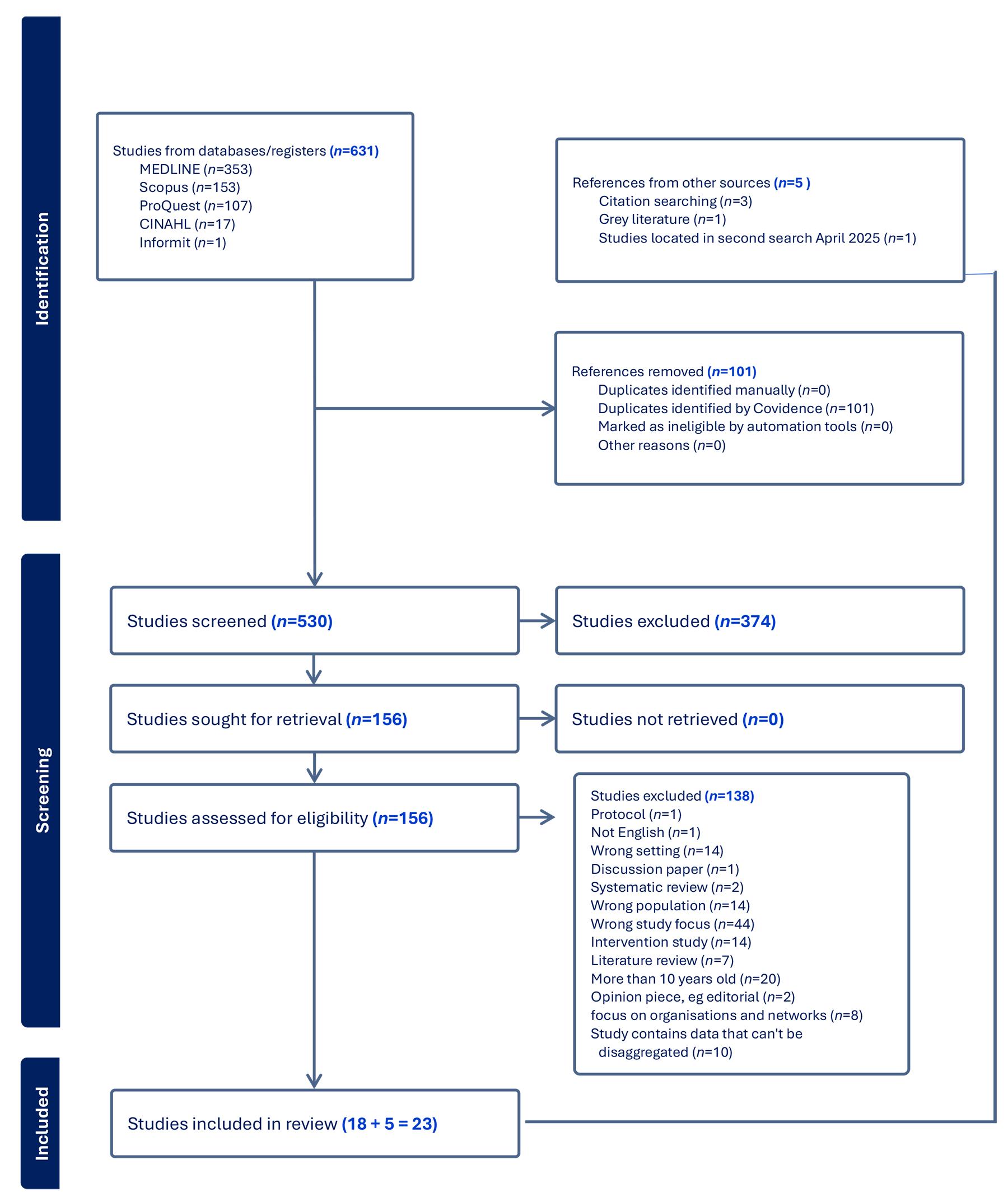 Figure 1: PRISMA flowchart.
Ethics approval
This is a review of previously published literature. Therefore, no ethics approval was required24.
Results
Research focus
As shown in Supplementary table 1, the 23 included sources were grouped into five categories:
- Seven primary research studies explored the unmet care and health needs of older adults living in rural areas25-31.
- One report by the Australian Government Office of the Inspector-General of Aged Care32 also explored unmet care and health needs, focusing on the implementation of recommendations from a Royal Commission conducted in Australia.
- Three studies focused on determining the demand and supply of care services, both institutional and community-based care33-35.
- Six primary research studies focused on older adults’ experiences with formal and informal services and supports available (these identified the facilitators and barriers of accessing and utilising services in rural areas)36-41.
- One study focused on older adults’ caregiving experiences42.
- Two studies focused on older adults’ experiences and perspectives of ageing in place and ageing well/healthy ageing43-47.
Characteristics of included research studies
In this scoping review, 22 studies were primary data sources, including qualitative, quantitative studies and mixed-methods approaches. Sixteen studies were qualitative, with a variety of research designs used. Six studies used thematic analysis26,27,37,41,46,47. An ethnographic approach was used in four studies25,31,39,40. Two studies used a variation of ethnography: Farrar et al42 used both ethnography and phenomenology, and Anderson et al47 used an ethnographic case study design. One study used descriptive questionnaire28. Neville et al used narrative gerontology38. Two studies used content analysis43,44. Five studies were quantitative, and all utilised a cross-sectional design29,30,33-35. In one study, Melchiorre et al used a mixed-methods design45. There was one item of grey literature from the Australian Government Office of the Inspector-General of Aged Care32.
Participant description
Participants in the included studies in this scoping review were primarily community-dwelling older adults aged 60 years and over. For Aboriginal and Torres Strait Islander people, an inclusion age of 45 years and over was applied, reflecting earlier onset of health inequities and lower life expectancy reported in the literature48. Across all studies, participants represented a diverse demographic across selected countries and study settings in terms of health conditions, living arrangements, having an informal or formal carer and access to healthcare resources. Additionally, participants were recruited from rural geographies where they lived in communities. This range of participant contexts was important to ensure a comprehensive understanding of older people’s health experiences, barriers and challenges to accessing aged care services and identification of potential enablers of good health and wellbeing.
Barriers, supports and services identified across the literature
Across the included literature, several recurring barriers to meeting the healthcare needs of older adults in rural areas were identified. Workforce shortages were frequently reported and affected access to primary care, specialist care, allied health and aged care services25,27,32,36,38,41. Limited service availability was compounded by high costs, transport difficulties, long travel distances and fragmented service systems27,32,36,38,39,41. Several studies also identified reduced mobility, cognitive decline, inadequate housing and poor transport infrastructure as barriers to ageing in place31,35,37,39,41,44,46.
At the same time, the review identified a number of supports that enabled older adults to remain at home. Informal caregiving by family members, neighbours and community networks was commonly described as essential, particularly where formal services were limited25,26,29,39,40,45. Social participation and community connectedness were also identified as important supports for wellbeing29,37,38,41,46,47. Several studies reported that older adults preferred home-based or family-provided care over institutional care, although this preference was often shaped by cultural values, financial constraints, and concern about separation, abandonment or relocation26,31,34,39-41,45. Technology-based options such as telehealth and digital monitoring were discussed as potential supports, but concerns were raised about digital access, internet reliability and the suitability of technology for socially isolated older adults34,38,44,45.
Discussion
This scoping review mapped the extent and nature of evidence relating to the healthcare needs of community-dwelling older adults in rural areas and showed persistent disparities in access to services, supports and resources required for ageing in place. The prominence of health workforce shortages across the literature suggests that access problems in rural ageing are not simply individual or geographic but are embedded in broader structural inequities in rural service systems.
Informal caregiving and community support emerged as a critical mechanism to compensate for the absence or inadequacy of formal services in areas28. Family members and community networks often provided essential support that enabled older adults to remain at home, particularly those with chronic illness, mobility challenges or increasing care needs29,30,34,40. The review further suggests that caregiving in rural areas is shaped by more than service availability alone. In particular the literature highlights the complexity of dementia care, where cultural expectations, caregiver knowledge and the limited availability of trained professionals influence the use of home- and community-based services26. At the same time, these informal support systems appear to be under increasing strain due to changing family dynamics, including the out-migration of younger generations, leading to increased caregiving demands25,33,45. Together, these findings suggest the need for service models that do not rely solely on family caregiving, instead re-imagining care systems that enable older adults to age in place independently or with targeted formal support.
The review also highlights the importance of social participation and community integration in promoting mental health and wellbeing of rural older adults29,37. Social participation is closely linked to improved mental and physical health and overall quality of life. Lester et al also identified mobility as a central determinant of rural ageing experiences35, linking reduced mobility to decreased access to services, heightened social isolation, and increased reliance on both formal and informal care. Nevertheless, some studies highlighted a discrepancy between this assumed value and the actual prioritisation of mental health support by older adults themselves. For example, Zhou et al found that only 2.4% of rural residents place value on mental health supports33. This finding aligns with a study by Henning-Smith et al 41, which noted stigma and cultural norms around self-reliance in rural communities, and with studies by Anderson et al47 and Detthippornpong et al40, whose participants tended to rely on internal or family-based coping strategies rather than formal mental health support. This suggests a need for more nuanced investigation of how rural older adults perceive, prioritise and engage with mental health support, rather than assuming formal mental health services will be universally valued or sought.
The preference for home-based and family-provided care across the literature reinforces the importance of ageing in place as both a practical and values-based goal for rural older adults. This preference is driven by cultural values, financial constraints and concerns of abandonment in institutional settings34,40. However, this review identified that ageing in place is not supported by preference alone. Cognitive decline, mobility limitations, and environmental limiters such as inadequate housing and transportation infrastructure can substantially constrain the ability of older adults to remain safely and meaningfully connected within their communities39,41. In many rural areas, limited or non-existent public transport and high-cost alternatives such as taxis affect not only access to health care and social services but also access to groceries, social activities and other basic supports for everyday living39,41. These findings suggest that ageing in place should be understood as dependent on broader social and environmental infrastructure, not simply an individual choice.
In rural areas, these challenges are compounded by fragmented care systems and a lack of resources. Several studies pointed to the need for stronger links between health and social services as well as more consistent care coordination36,37,45. The literature also suggests that engagement with formal services is shaped by cultural values, spiritual beliefs and social norms, with many older adults continuing to prefer family-based, informal care where possible31,39,40. The adoption of technology such as telehealth and digital monitoring tools was frequently proposed as a solution; however, concerns remain about its suitability for socially isolated populations, particularly when access to reliable internet is limited or when some older adults express ambivalence toward technological care34,38,44.
Importantly, some studies challenged any assumption that rural ageing is a homogenous experience. Karlin43 and Anderson et al47 emphasised that ageing trajectories and coping strategies vary widely between individuals, even within the same geographical regions. These findings point to the importance of designing services that are flexible and responsive to individual needs rather than assuming homogeneity among rural adults.
Limitations
Scoping reviews provide a broad overview of the literature and are useful to inform future research. However, they have limitations, including a lack of critical appraisal, making it difficult to assess the quality of included studies19,20. A critical appraisal of studies was conducted using the Mixed Methods Appraisal Tool23 and the findings presented; however, the ensuing discussion is descriptive rather than interpretive18. Given this review has identified 23 studies, as recommended by Tricco et al21 the research team will now consider conducting a systematic review to examine the topic in greater depth.
Conclusion
This scoping review has provided a comprehensive examination of the healthcare needs for community-dwelling older people in rural areas, revealing persistent disparities in healthcare access, workforce shortages and service coordination. Future research should explore sustainable and scalable models of care that address these challenges while considering the unique sociocultural contexts of rural ageing populations. The implications for health providers, government and policymakers are the prioritisation of investment in research with a focus on rural healthcare infrastructure, workforce development and community-based interventions to support the evolving needs of older adults. Addressing these issues through targeted, evidence-informed and contextually relevant strategies will be essential to ensuring equitable and high-quality care for older people in rural areas.
Acknowledgements
The authors acknowledge Ms Lorraine Rose, Faculty Librarian (Science and Health), Charles Sturt University, and thank her most sincerely for her assistance throughout the review process.
Funding
The scoping review was conducted as part of a research project funded by the Rural Health Research Institute. The Rural Health Research Institute played no role in the design, execution, analysis or interpretation of the scoping review beyond providing financial support. The research team independently conducted all aspects of the review, including study selection, data extraction, collating, summarising and reporting of findings.
Conflicts of interest
The authors declare that they have no known competing financial interests or personal relationships that could have influenced the work reported in this article.
AI disclosure statement
The authors did not use AI or AI-assisted tools in any aspect of the development of this article.